
 Contact Us
About GoS
Now in its 28th year, and
Contact Us
About GoS
Now in its 28th year, andstill amateur & advert-free Please do not copy GoS
material without asking

Can you help? This page is the result of the best endeavours of all concerned. If you spot a mistake or know of facts to add, or have a better photo, please get in touch using 'Contact Us' (top, right).
Back to GoS-DB Hub Find Another Player
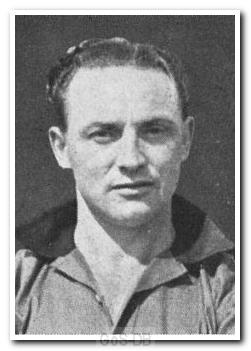
ALBERT HALL
Full Name: Albert Edwards Benjamin Hall (also known as Bert)
Born: 03 September 1918
Came from: Tottenham Hotspur Went to: Chelmsford City
First game: 23 August 1947 Last game: 11 October 1947
Appearances: 9 (9/0) Goals: 0
Born in Cadoxton, a suburb of Barry in south Wales, he was a Welsh schoolboy international.
Impressively, in 1932 he and his brother saw a seven-year-old girl struggling in a pond near their home and Bert, as he was always known, dived in and pulled her to safety. For this selfless act he was awarded a Royal Humane Society Award for Bravery.
His father had been a player with Swansea Town, who would later become Swansea City, and thought his son would become a boxer. However, when Bert won the first of his three Welsh schoolboy caps, he was spotted by a Spurs scout who described him as 'a trier with lots of stamina as well as a powerful shot'. He won three caps at that level, scoring once in a game against England.
He initially joined Tottenham Hotspur at just 14 and went on to spend almost 15 years with the club. He joined one of the club's nursery sides, which was run from Ebbw Vale, and was a member of a South Wales XI who played against Spurs' youngsters. His side lost 7-1, but he had done enough to sign for Tottenham as an amateur, playing for the junior side during 1934-35.
As an amateur, he was found work at Haywards, a local factory in north London, and trained several evenings a week at White Hart Lane, living in one of the houses the club owned at the time in Roedean Avenue, with several first-team players living next door. He went on to turn professional in the autumn of 1935 for the then Second Division side.
However, the interruption of the Second World War meant that he made only 45 appearances for the club, scoring 11 goals. During the war he guested for many clubs across the country, including Port Vale, Short Brothers, a Belfast-based works team of an aircraft manufacturer, Norwich City, Luton Town, Charlton Athletic, Chelsea, Reading, Millwall and Watford.
As well as his goals for Spurs, he scored 10 wartime goals in 33 games. What he might have achieved but for the intervention of the Second World War will never be known.
Having played for Spurs and guested for Norwich City at the beginning of the Second World War, he joined the Royal Artillery but was captured by the Japanese at the Fall of Singapore in 1942. As a Prisoner of War (POW), he was tortured by his captors and held at the notorious Changi Camp, where he was forced into brutal work on the infamous construction of the Burma railway.
In September 1944, he was being transported by ship to Japan when it was attacked by American submarines, and his vessel was one of two sunk. For the next four days he clung to wreckage and rafts, watching friends perish in front of him, before the Americans returned to the area and rescued him. He was taken aboard the submarine Sealion, the same vessel which had sunk his captors' ship. The convoy had set off with more than 2,000 POWs; just 159 were saved by the Americans, while more than 600 were picked up by the Japanese. A total of around 1,400 perished at sea.
Returning to England via the USA, he re-joined Spurs. Many who knew him said that he was not the same man as he had been before his capture, and many thought his play never reached the same heights. With what he had endured, the trauma appears to have affected him into later life, with reports that he showed signs of what would now be recognised as Post-Traumatic Stress Disorder (PTSD).
He was, however, signed by Argyle manager Jack Tresadern, his former manager at White Hart Lane. His form for Argyle was disappointing, though perhaps, given the circumstances, not entirely surprising, and he left the club after just one season and nine appearances, in which he failed to score, ending his career with Southern League side Chelmsford City.
Eventually forced to retire from football due to a persistent knee injury, he continued to be a regular visitor to White Hart Lane to watch Spurs play and worked locally at Enfield Rolling Mills until he moved away from the area.
He then worked for BICC (British Insulated Callender's Cables) as a capstan operator - the company was responsible for cables and fittings used in the modernisation and electrification of the rail network. Later in life, Bert was living in Shrewsbury, where BICC had a plant, so it is likely that he moved there for the role.
He continued to closely follow Spurs' fortunes and remained in Shropshire until he passed away in Shrewsbury in February 1998, aged 79.
YOUR CONTRIBUTION
If you can add to this profile, perhaps with special memories, a favourite story or the results of your original research, please contribute here.
APPEARANCE DETAILS [reselect competitions]
The details below reflect appearances in all first-team competitions.
We are very grateful to many who have helped write GoS-DB's player pen-pictures, and to Dave Rowntree and the PAFC Media Team for their help with photos. Thanks also to staff at the National Football Museum, the Scottish Football Museum and ScotlandsPeople for their valuable assistance.
The following publications have been particularly valuable in the research of pen-pictures: Plymouth Argyle, A Complete Record 1903-1989 (Brian Knight, ISBN 0-907969-40-2); Plymouth Argyle, 101 Golden Greats (Andy Riddle, ISBN 1-874287-47-3); Football League Players' Records 1888-1939 (Michael Joyce, ISBN 1-899468-67-6); Football League Players' Records 1946-1988 (Barry Hugman, ISBN 1-85443-020-3) and Plymouth Argyle Football Club Handbooks.
Greens on Screen is run as a service to fellow supporters, in all good faith, without commercial or private gain. We have no wish to abuse copyright regulations and apologise unreservedly if this occurs. If you own any of the material on this site, and object to its inclusion, please get in touch using the 'Contact Us' button at the top of the page.