
 Contact Us
About GoS
Now in its 28th year, and
still amateur & advert-free Please do not copy GoS
material without asking

Can you help? This page is the result of the best endeavours of all concerned. If you spot a mistake or know of facts to add, or have a better photo, please get in touch using 'Contact Us' (top, right).
Back to GoS-DB Hub Find Another Player
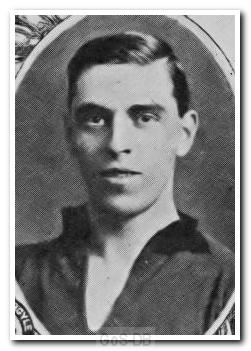
FRANK COSGROVE
Note: Unofficial record books call him Fred Cosgrove, but we've found three strong pieces of contemporary evidence to say he was Frank (the 1920-21 PAFC Handbook, the UK Incoming Passenger List for his return from the 1924 tour of South America, and an advert for his benefit match in the Western Morning News in 1929). Subsequent enquiries have revealed that the Football League ledgers for the 1920s also record him as Frank. Whether Fred was an informal nickname, or just a mistake in modern records, is not known.
Full Name: Francis Michael Cosgrove
Born: 05 December 1894
Came from: Durham City Went to: Retired
First game: 26 February 1921 Last game: 14 February 1931
Appearances: 105 (105/0) Goals: 0
Although some sources suggest a birth in Hartlepool or elsewhere in County Durham, tracing his details back from his death certificate has established that he was born in Crook, in the registration district of (Bishop) Auckland.
Cosgrove began playing for Felling Colliery after working as a coal miner, before being spotted and moving to the newly formed Durham City. Founded in 1918, the club was elected to the Third Division North in 1921.
He was spotted by Bob Jack, quite possibly during one of his many scouting trips to or from his native Scotland, given Cosgrove's geographical location. Having impressed, he was signed and made the long move to Plymouth in 1920. A right-back, he spent 11 seasons at Home Park, featuring from Argyle's first season in the Football League through to their first campaign in Division Two.
Despite his lengthy stay, he made only 105 appearances, in an era when Home Park had a number of quality players competing for places. Players such as Harry 'Jazzo' Kirk, Alf Rowe, Albert Fishwick, Perry Richard and Cosgrove himself wore the colours with pride when given their chance, but all struggled to secure extended runs in the side. Some left to try their luck elsewhere, but Cosgrove remained.
With established players such as Moses Russell and Billy Forbes regular starters during the early part of his time at the club, breaking into the side was difficult, and he was regarded as a reliable reserve. However, during the 1924-25 season, between Forbes's retirement and the arrival of Fred Titmuss, he became a regular partner for Russell.
Cosgrove had made his debut in February 1921, in a 1-0 home win against Swansea Town (later Swansea City), and went on to make more than a century of appearances in green without scoring. He also featured in Argyle's summer tour of South America in 1924, playing in seven of the nine matches against Rosario (twice) as well as the national sides of Uruguay (twice) and Argentina (three). He missed only one of the four games against Argentina and the match with Boca Juniors.
In 1931, aged 36, he called time on his career, with Argyle his only Football League club. Returning north, he played for Benwell Colliery, near Newcastle, later that year. There is some evidence of a Frank Cosgrove briefly joining the Army before being medically discharged within a week because of a previous bout of tuberculosis. However, this is believed to have been a different man, as the Argyle player would have been in a reserved occupation as a coal miner.
Little was known about his later life, or even his precise date of birth, until the discovery of his death certificate. He eventually settled in Kirkburton, near Huddersfield in what is now West Yorkshire, quite possibly drawn to the area by the availability of work in the local mines.
He passed away in March 1957, aged 62, at North Spring House, Kirkburton. The actual location of his death was Storthes Hall Hospital, a psychiatric hospital in Thurstonland, within the Kirkburton area. To avoid unnecessary stigma, deaths at the hospital were sometimes recorded as having taken place at "North Spring House, Kirkburton" in death and probate records. North Spring was the name of the woods beside the facility.
He passed away from septicaemia and heart-related complications, having suffered the lasting effects of a suspected stroke. This may also help explain why he was at the hospital at the time of his death.
His death certificate recorded his previous occupations as 'coal miner' and, notably, 'professional footballer'. The link to his birth record came through the signatory who reported his death, T E Jones, his brother-in-law. A search revealed that a T E Jones had married a Rose A Cosgrove in the March quarter of 1925, in the registration district of (Bishop) Auckland, the same district in which Frank had been born as Francis Michael.
Although his middle name was omitted from the death certificate, and he was registered as Frank rather than Francis, this may simply be because his brother-in-law knew him by the name Frank and was unaware that he had a middle name. No other identified Frank Cosgrove birth record matches the location or can be linked to the death certificate and the age of 62 in the same way.
YOUR CONTRIBUTION
If you can add to this profile, perhaps with special memories, a favourite story or the results of your original research, please contribute here.
APPEARANCE DETAILS [reselect competitions]
The details below reflect appearances in all first-team competitions.
We are very grateful to many who have helped write GoS-DB's player pen-pictures, and to Dave Rowntree and the PAFC Media Team for their help with photos. Thanks also to staff at the National Football Museum, the Scottish Football Museum and ScotlandsPeople for their valuable assistance.
The following publications have been particularly valuable in the research of pen-pictures: Plymouth Argyle, A Complete Record 1903-1989 (Brian Knight, ISBN 0-907969-40-2); Plymouth Argyle, 101 Golden Greats (Andy Riddle, ISBN 1-874287-47-3); Football League Players' Records 1888-1939 (Michael Joyce, ISBN 1-899468-67-6); Football League Players' Records 1946-1988 (Barry Hugman, ISBN 1-85443-020-3) and Plymouth Argyle Football Club Handbooks.
Greens on Screen is run as a service to fellow supporters, in all good faith, without commercial or private gain. We have no wish to abuse copyright regulations and apologise unreservedly if this occurs. If you own any of the material on this site, and object to its inclusion, please get in touch using the 'Contact Us' button at the top of the page.