 Contact Us
About GoS
Now in its 28th year, and
Contact Us
About GoS
Now in its 28th year, andstill amateur & advert-free Please do not copy GoS
material without asking
Thanks to Dave Rowntree for many of the player images after 1984.
Can you help? This page is the result of the best endeavours of all concerned. If you spot a mistake or know of facts to add, or have a better photo, please get in touch using 'Contact Us' (top, right).
Back to GoS-DB Hub Find Another Player
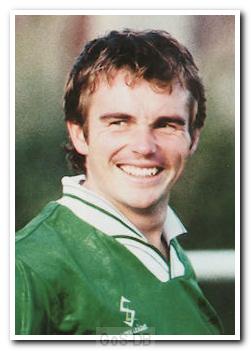
MARTIN BARLOW
Born: 25 June 1971
Came from: Trainee Went to: Exeter City
First game: 06 May 1989 Last game: 17 February 2001
Appearances: 378 (341/37) Goals: 26
Born in Barnstaple in June 1971, Martin Barlow became one of Argyle’s most familiar and popular players of the 1990s. Although his father was serving with the RAF in North Devon when he was born, Barlow moved to Plymouth as a toddler and spent almost his entire footballing education with the Pilgrims.
A pupil at Honicknowle Secondary Modern School, Barlow represented Devon Schools and played for local side Prince Rock before joining Argyle’s Centre of Excellence. Initially signed as an associated schoolboy, there were concerns that his slight build might prevent him from making the grade, and his father arranged trials with Exeter City. Those doubts disappeared after an impressive trial match at Harper’s Park where, despite being played out of position at full-back, he did enough to earn an apprenticeship. Barlow made his first-team debut as a substitute in a 3-1 victory over Oxford United in May 1989 and signed his first professional contract two months later.
Naturally a right winger, Barlow’s early progress was interrupted by a hernia operation that restricted him to a single substitute appearance the following season. His breakthrough eventually came under David Kemp, who preferred him to David Byrne on the right flank. Confident in possession and always willing to take on defenders, Barlow quickly established himself as an exciting attacking outlet. His first senior goal came in a 3-2 defeat at Brighton & Hove Albion, earning him the Barclays Young Eagle of the Month award and attracting interest from Aston Villa, whose approach for the promising youngster was rejected by Argyle.
Affectionately nicknamed ‘Chopsy’ because of his constant chatter with senior players on the training ground, Barlow brought the same confidence and energy to his football. Fearless in possession and never one to shirk responsibility, he nevertheless found opportunities limited following Peter Shilton’s arrival as manager, eventually losing his place to the reserves. Assistant manager John McGovern recognised that Barlow’s work rate, energy and ability to link play were better suited to midfield, and the positional change transformed his career. Despite standing only 5ft 7in, he covered enormous distances, collected possession from deep areas and drove Argyle forward with intelligent passing and quick turns, re-establishing himself as a key player during the memorable 1993-94 campaign.
Neil Warnock’s appointment in the summer of 1995 initially appeared to signal the end of Barlow’s Home Park career. Out of contract and unconvinced by the terms on offer, he began the season on a week-to-week agreement while Cardiff City considered making a move. Instead, he produced arguably the finest football of his career and earned a new two-and-a-half-year contract. His contribution to Argyle’s promotion challenge was immense. Six man-of-the-match awards underlined his influence, including an outstanding performance and two goals in a 5-1 victory over Scarborough. Although he endured a disappointing first leg in the play-off semi-final at Colchester, Warnock retained his faith in him for the return match. Barlow repaid that confidence by delivering the cross from which Paul Williams headed the dramatic winner that sent Argyle to Wembley. Promotion in the play-off final remains one of the defining achievements of his career and a fitting reward for his outstanding form throughout the run-in.
The closing years of Barlow’s Argyle career were defined as much by resilience as ability. A persistent groin injury plagued him for almost two seasons and, determined not to let his teammates down, he regularly played through considerable pain, at times relying on painkillers simply to get through matches. Despite those physical struggles, his performances rarely declined, and he shared the club’s Player of the Year award with Carlo Corazzin during the difficult 1997-98 relegation campaign.
His loyalty was recognised with a testimonial against Fulham in July 1999, although injury prevented him from taking a full part. Unable even to jog comfortably, he received a warm ovation before kicking off and leaving the field almost immediately. Two operations followed in an attempt to resolve his groin and stomach problems, delaying his return for seven months. His first league start after recovering lasted only 17 minutes before knee ligament damage ended his season once again.
Kevin Hodges’ arrival as manager briefly revived Barlow’s prospects. He later admitted that the appointment of his former mentor, whose boots he had cleaned as an apprentice, was a major factor in persuading him to sign another contract. However, another managerial change altered his fortunes. Paul Sturrock made it clear that Barlow was no longer part of his long-term plans and, after a loan spell with Yeovil Town, he left Home Park at the start of the 2001-02 season to join Exeter City, ending a remarkable 12-year association with Argyle. By then he had made 378 appearances and scored 26 goals, establishing himself as one of the club’s most committed and dependable servants during one of the most turbulent periods in its history.
Barlow spent a season with Exeter City before later spells at Weymouth and Telford United, retiring from professional football in 2003. Although injuries undoubtedly curtailed his career, his enthusiasm, work rate and commitment ensured he remained a firm favourite with the Green Army. His spectacular volley against Shrewsbury Town in April 1999, struck from a tight angle after meeting a headed clearance, remains one of the finest goals scored at Home Park.
YOUR CONTRIBUTION
If you can add to this profile, perhaps with special memories, a favourite story or the results of your original research, please contribute here.
APPEARANCE DETAILS [reselect competitions]
The details below reflect appearances in all first-team competitions.
I'm very grateful to many who have helped write GoS-DB's player pen-pictures, and to Dave Rowntree, the PAFC Media Team and Colin Parsons for their help with photos. Thanks also to staff at the National Football Museum, the Scottish Football Museum and ScotlandsPeople for their valuable assistance.
The following publications have been particularly valuable in the research of pen-pictures: Plymouth Argyle, A Complete Record 1903-1989 (Brian Knight, ISBN 0-907969-40-2); Plymouth Argyle, 101 Golden Greats (Andy Riddle, ISBN 1-874287-47-3); Football League Players' Records 1888-1939 (Michael Joyce, ISBN 1-899468-67-6); Football League Players' Records 1946-1988 (Barry Hugman, ISBN 1-85443-020-3) and Plymouth Argyle Football Club Handbooks.
Greens on Screen is run as a service to fellow supporters, in all good faith, without commercial or private gain. We have no wish to abuse copyright regulations and apologise unreservedly if this occurs. If you own any of the material on this site, and object to its inclusion, please get in touch using the 'Contact Us' button at the top of the page.