 Contact Us
About GoS
Now in its 28th year, and
Contact Us
About GoS
Now in its 28th year, andstill amateur & advert-free Please do not copy GoS
material without asking
Can you help? This page is the result of the best endeavours of all concerned. If you spot a mistake or know of facts to add, or have a better photo, please get in touch using 'Contact Us' (top, right).
Back to GoS-DB Hub Find Another Player
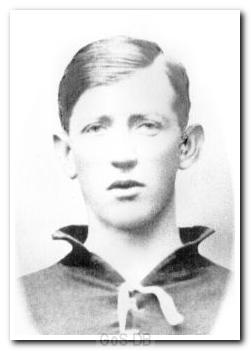
JACK HILL
Full Name: John Henry Hill
Born: 02 March 1897
Came from: Durham City Went to: Burnley
First game: 08 September 1920 Last game: 28 April 1923
Appearances: 111 (111/0) Goals: 10
Hill was born at Hetton-le-Hole, County Durham and, after playing junior football locally whilst working as a coalminer, he saw action at Gallipoli and Salonika with the East Yorkshire Regiment during the First World War. After the hostilities ceased, he joined Durham City in 1919.
He moved to Argyle in September 1920, as a Bob Jack signing, after the club had recently been admitted to the Football League Third Division, as it was called in its maiden season. Hill joined up with Moses Russell in the Argyle defence for the first season of League football in 1920-21 after playing as an amateur with Durham City. Despite spending only three seasons at Home Park, he is regarded as one of the outstanding players in the club's history. At 6ft 3", he was a powerfully built and imposing centre-half. His height was an advantage in both defence and attack, where he induced panic at corners and free kicks, but for such a large man he was also extremely skilful.
He remained for three seasons at Home Park, in the last two of which (1921-22 & 1922-23) Argyle finished as runners-up in the Third Division (South) - as the league was then known - missing out on the single promotion place available firstly to Southampton on goal difference and then to Bristol City.
After 111 appearances in green and 10 goals, other clubs had certainly taken note. In May 1923, he was sold to First Division Burnley for a fee of £5,450 (just under £500,000 in 2026 terms) and adjusted to top-flight football with great ease. He quickly became a key part of the Clarets' defence and having previously represented a Southern League XI and a Football League XI, full England international honours followed. He made his England debut in 1925 against a Welsh side that contained, ironically, Moses Russell. A further 10 England caps were to come his way, as well as the England captaincy. The majority of his caps were in the British Home Championships, but in May 1927 England went on a three-match tour of Europe, and he played against Belgium, Luxembourg and France.
In total, Hill spent five years at Burnley and played 184 times, scoring 13 goals. In October 1928, he moved to Newcastle United, and as local rivals Sunderland were also keen to sign him, Newcastle needed to pay a record transfer fee of £8,100 to secure his services. Described initially, in the local press, as being "tall and lanky", he soon became Newcastle's captain and "with his willingness to move forward from defence and his quality of distribution", he was also a great favourite with the fans.
In May 1929, he was recalled to the England team as captain for a tour of Europe when they defeated France 4-1 and Belgium 5-1, and played Spain for the first-time ever, with Spain prevailing 5-4 in a thriller. In total, Hill had earned 11 caps, of which eight were as captain, with a record of six victories, one draw and four defeats.
However, unfortunately, after only a couple of seasons at St James' Park, he fell into dispute with Newcastle's directors, which led to his premature departure, leaving for Bradford City in June 1931 for a fee of £7,500.
He only stayed at Bradford until November 1931, playing eight times and scoring once, before he was on the move again in a player-exchange deal, moving to Hull City with Stan Alexander going the other way. In his third season, he helped Hull win the Third Division (North) title. Despite his international recognition, surprisingly, this was to be the only club honours he won during his 15-year playing career.
After three seasons with Hull as a player, in which had had played 94 times and scored twice, in March 1934 he took over the managerial reins at the club. In his first season in charge, the Tigers finished comfortably mid-table in the Second Division. Things took a slide in the following season, and in January 1936, Hill was dismissed. As manager, Hill only won 24 out of 77 games, a win rate of 31.2%.
After the Second World War, Hill returned to Hull City where he acted as club scout from 1948 to 1955. He later had a spell at Scarborough, where he was in charge of their Football Pools scheme.
He retired in August 1963 and moved further up the east coast, to Scotland where he lived in Helensburgh, until he passed away, in April 1972, aged 75 years old.
YOUR CONTRIBUTION
If you can add to this profile, perhaps with special memories, a favourite story or the results of your original research, please contribute here.
APPEARANCE DETAILS [reselect competitions]
The details below reflect appearances in all first-team competitions.
I'm very grateful to many who have helped write GoS-DB's player pen-pictures, and to Dave Rowntree, the PAFC Media Team and Colin Parsons for their help with photos. Thanks also to staff at the National Football Museum, the Scottish Football Museum and ScotlandsPeople for their valuable assistance.
The following publications have been particularly valuable in the research of pen-pictures: Plymouth Argyle, A Complete Record 1903-1989 (Brian Knight, ISBN 0-907969-40-2); Plymouth Argyle, 101 Golden Greats (Andy Riddle, ISBN 1-874287-47-3); Football League Players' Records 1888-1939 (Michael Joyce, ISBN 1-899468-67-6); Football League Players' Records 1946-1988 (Barry Hugman, ISBN 1-85443-020-3) and Plymouth Argyle Football Club Handbooks.
Greens on Screen is run as a service to fellow supporters, in all good faith, without commercial or private gain. We have no wish to abuse copyright regulations and apologise unreservedly if this occurs. If you own any of the material on this site, and object to its inclusion, please get in touch using the 'Contact Us' button at the top of the page.