 Contact Us
About GoS
Now in its 28th year, and
Contact Us
About GoS
Now in its 28th year, andstill amateur & advert-free Please do not copy GoS
material without asking
Can you help? This page is the result of the best endeavours of all concerned. If you spot a mistake or know of facts to add, or have a better photo, please get in touch using 'Contact Us' (top, right).
Back to GoS-DB Hub Find Another Player
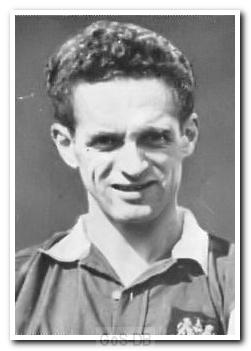
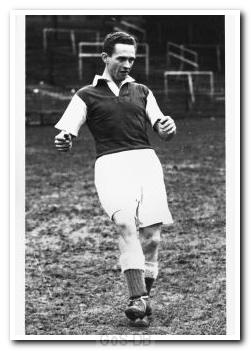
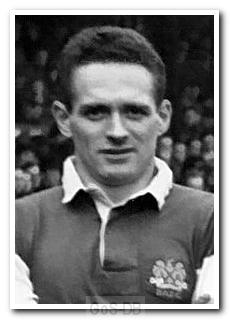
NEIL DOUGALL
Full Name: Cornelius Dougall
Born: 07 November 1921
Came from: Birmingham City Went to: Appointed Manager
First game: 12 March 1949 Last game: 13 December 1958
Appearances: 290 (290/0) Goals: 26
Dougall began his senior football career with Burnley in 1940 without making a first-team appearance. In spite of the upheaval of the Second World War, he found opportunities to play at a high level. While serving in the RAF, he represented the Air Force Wartime XI and also made guest appearances for Oldham Athletic, Watford, Walsall and Coventry City. His wartime football included appearances for Scotland in unofficial internationals.
Following the war, Dougall moved to Birmingham City, where he initially played as an inside-forward. In 1946 he represented Scotland against England in a Victory international before gaining his only full international cap later that year. Football was not yet his sole occupation, as he was also undertaking an apprenticeship with a printing firm. Nonetheless, he became established in Birmingham City’s first team and helped the club win the Second Division championship in 1947-48 before Argyle signed him for £13,000 in March 1949.
Dougall made his Argyle debut against West Bromwich Albion on 12 March 1949. Injuries hampered his progress during his first full season at Home Park, which ended with the club’s relegation, but a change of position subsequently helped him establish himself as an important member of the side. Having arrived principally as an inside-forward, he was converted to right-half, where his pace and intelligent distribution proved particularly effective.
Although right-half became the position most closely associated with him at Argyle, Dougall’s adaptability was one of his greatest assets. Over the course of his time at Home Park he was used throughout the team, appearing in every position other than goalkeeper and outside-left. At half-back he played alongside Jack Chisholm and Johnny Porteous as Argyle rebuilt following relegation, and he was a member of the side that won the Third Division (South) championship in 1951-52.
Dougall remained an influential and versatile member of the team as its personnel changed around him during the 1950s. The emergence of Johnny Williams in 1956 led to him being employed again in more attacking positions, on either the inside or outside right. He enjoyed a productive 1956-57 campaign, scoring nine times, with braces against both Northampton Town and Swindon Town.
His immense versatility was called upon once more towards the end of his playing career. Dougall succeeded Pat Jones at left-back for a period and was playing in defence during his final appearances for the club. His last first-team appearance was at Bradford City on 13 December 1958. Although he did not feature again during the campaign, he gained another championship medal when Argyle secured the Third Division title in 1958-59. His playing career at Home Park ended with 290 first-team appearances and 26 goals.
Dougall’s association with Argyle continued after he left the first team. Having already obtained his FA coaching qualifications, he became player-coach of the reserves. When Jack Rowley left the club in 1959, Dougall was appointed chief coach and George Taylor chief trainer, with Dougall subsequently becoming team manager the following season.
His spell in management proved relatively brief, as he decided that the role was not suited to him. He was succeeded by Ellis Stuttard in November 1961. He nevertheless remained closely involved with Argyle, working in coaching and scouting and later undertaking public relations duties. He also played a part in some of the club’s early organised fundraising activities.
Dougall finally left Home Park in the early 1970s, but continued working in Plymouth. After running a fitness club in the city, he took charge of the Mayflower Sports Centre, adjacent to Home Park, in 1973. He remained there until retiring in 1986, bringing to an end a working life in Plymouth that had begun with his arrival at Argyle almost four decades earlier. He died in December 2009 aged 88 after a long battle with Alzheimer’s disease.
YOUR CONTRIBUTION
If you can add to this profile, perhaps with special memories, a favourite story or the results of your original research, please contribute here.
APPEARANCE DETAILS [reselect competitions]
The details below reflect appearances in all first-team competitions.
I'm very grateful to many who have helped write GoS-DB's player pen-pictures, and to Dave Rowntree, the PAFC Media Team and Colin Parsons for their help with photos. Thanks also to staff at the National Football Museum, the Scottish Football Museum and ScotlandsPeople for their valuable assistance.
The following publications have been particularly valuable in the research of pen-pictures: Plymouth Argyle, A Complete Record 1903-1989 (Brian Knight, ISBN 0-907969-40-2); Plymouth Argyle, 101 Golden Greats (Andy Riddle, ISBN 1-874287-47-3); Football League Players' Records 1888-1939 (Michael Joyce, ISBN 1-899468-67-6); Football League Players' Records 1946-1988 (Barry Hugman, ISBN 1-85443-020-3) and Plymouth Argyle Football Club Handbooks.
Greens on Screen is run as a service to fellow supporters, in all good faith, without commercial or private gain. We have no wish to abuse copyright regulations and apologise unreservedly if this occurs. If you own any of the material on this site, and object to its inclusion, please get in touch using the 'Contact Us' button at the top of the page.