 Contact Us
About GoS
Now in its 28th year, and
Contact Us
About GoS
Now in its 28th year, andstill amateur & advert-free Please do not copy GoS
material without asking
Can you help? This page is the result of the best endeavours of all concerned. If you spot a mistake or know of facts to add, or have a better photo, please get in touch using 'Contact Us' (top, right).
Back to GoS-DB Hub Find Another Player
JACK CHISHOLM
Full Name: Jack Richardson Chisholm
Born: 09 October 1924
Came from: Sheffield United Went to: Retired
First game: 24 December 1949 Last game: 26 April 1954
Appearances: 188 (188/0) Goals: 2
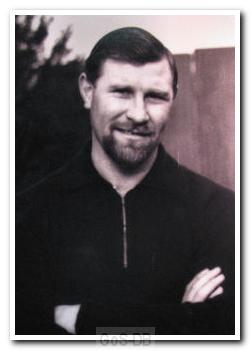
Chisholm was an industrious and commanding centre-half and was born in Edmonton, then in Middlesex, but now in modern-day North London.
He began his career as a teenager with Tottenham Hotspur in 1942, but war service soon took precedence. He served with the Irish Guards and appeared for Millwall and Fulham as a wartime guest, while also playing a single game for Bedford Town in 1945. He returned to football full-time at White Hart Lane after the war, aged 23. He found it hard to break into the first team, so moved to Brentford in 1947 in a part-exchange with Cyril Toulouse, having made just two appearances for Spurs in 1946-47. After 18 months at Griffin Park, during which he played 49 times and scored once, in the 1947-48 season, he was sold to Sheffield United for £16,000.
At Bramall Lane, he made 21 appearances in the top-flight, or First Division as it then was, and netted his first goal, before being sold to Argyle six months later for either £12,000 or £14,000 (both figures are quoted), money that would turn out to be very well spent by manager Jimmy Rae in his search for an imposing defender.
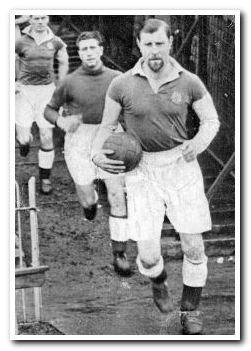
Chisholm lacked almost all the necessary components to become a top footballer - he had little speed, agility, stamina or genuine skill. 'Jumbo', as he was unsurprisingly nicknamed due to his physique, however, imprinted his name in Argyle history with his leadership qualities and sheer physical presence at centre-half. He was a giant in the air and a thunderous tackler, but it was his ability to cajole his more talented colleagues into action that made him so important to the club.
He was soon appointed captain and joined a club battling a relegation that he was unable to prevent, as the club slipped back into the third tier. However, he would go on to help Argyle challenge for promotion to the First Division after helping the club return to the second tier, after just two seasons away, in 1951-52, as Third Division South champions. Argyle finished that season as runaway champions, five points clear of second-placed Reading, managing to score 107 goals.
Injuries and lifestyle sadly ended his career just two years later; he had cartilage removed from both knees and was reputed to enjoy a drink in the Britannia Inn both before and after home games. That didn't prevent him from helping the club to its joint highest all-time finish of 4th in the Second Division in 1952-53, however, a close brush with the so-called 'Promised Land'. He grew his trademark beard, ironically towards the end of his career, in an era when he was one of few players with one, yet it is often that which he is most known by.
Perhaps unusually, having not clocked up the oft-traditional 10 years, but illustrating the esteem in which he was held, he was awarded a Testimonial game. Argyle took on a combined WBA/Tottenham Hotspur XI, running out 3-2 winners in May 1955 in front of a delighted Home Park crowd.
Early in his career, he was also a talented cricketer and, as well as playing for the MCC, played a single first-class game for Middlesex in the same team as Dennis Compton (another footballer-cricketer) and Bill Edrich. The match was against Oxford University (though still classed as a first-class game) in June 1947, in Oxford, and was a loss for Middlesex. Chisholm was a right-handed batsman and a right-arm fast bowler. He scored 14 runs in the three-day match's two innings and took a single wicket with perfectly reasonable figures of 33-1 off 10 overs. He later played Minor Counties cricket for Bedfordshire (1949-51) and Devon (in 1956 after he had finished with Argyle).
Having retired from football and departed Home Park, he moved initially to Cornwall, managing Helston Athletic at football and playing cricket for St Just. He then returned to Plymouth to run the Harvest Home pub, although this was relatively short-lived as he proved to be too generous a host to sustain a profit! Jack then returned to the London area and initially managed Finchley in 1956 (half of what became the modern-day Wingate & Finchley in 1991) before then becoming Romford's first professional manager in 1958 and guiding them into the Southern League. He stayed with Romford until 1962.
Jack's career antics even resulted in him coming to the attention of the 'red top' press in the early 1960s, with a sensationalised series of sordid (and quite possibly paid for) interviews with 'Pirate Chisholm' as he was dubbed, on "Bribes, birds and booze-ups". These were published by the Sunday People over a number of weeks in January and February 1963. In modern times such things would often be the prelude to a book release but in this instance no book followed.
In his later years, he then moved back to his birthplace, Edmonton, to run a betting shop. Unfortunately, Jack’s lifestyle hadn't been overly conducive to a long life and he died on 24th August 1977 in Leytonstone, in East London, aged just 52.
He did live long enough however, to enjoy a wonderful reunion with his 1951-52 championship team, pictured on a rare visit back to Home Park in the early 1970s, grinning from ear-to-ear in Harley Lawer's "Argyle Classics" book, alongside George Robertson, Bill Shortt, Bill Harper (as a special guest, as trainer of that team), Pat Jones, Tony McShane, Gordon Astall, Neil Dougall, Johnny Porteous and Alex Govan. It was to be that team's only reunion due to Jack's sudden death just a few years later.
The legend of Jack as a magnificent Pilgrim continued to live on. He was inducted into the club's Hall of Fame in 2004 and the club's Team of the Century the same year. He also had one of the club's hospitality lounges named after him, in which an imposing oil painting of him hung, which survived until the redevelopment of Home Park's south side in 2018.
YOUR CONTRIBUTION
If you can add to this profile, perhaps with special memories, a favourite story or the results of your original research, please contribute here.
APPEARANCE DETAILS [reselect competitions]
The details below reflect appearances in all first-team competitions.
I'm very grateful to many who have helped write GoS-DB's player pen-pictures, and to Dave Rowntree, the PAFC Media Team and Colin Parsons for their help with photos. Thanks also to staff at the National Football Museum, the Scottish Football Museum and ScotlandsPeople for their valuable assistance.
The following publications have been particularly valuable in the research of pen-pictures: Plymouth Argyle, A Complete Record 1903-1989 (Brian Knight, ISBN 0-907969-40-2); Plymouth Argyle, 101 Golden Greats (Andy Riddle, ISBN 1-874287-47-3); Football League Players' Records 1888-1939 (Michael Joyce, ISBN 1-899468-67-6); Football League Players' Records 1946-1988 (Barry Hugman, ISBN 1-85443-020-3) and Plymouth Argyle Football Club Handbooks.
Greens on Screen is run as a service to fellow supporters, in all good faith, without commercial or private gain. We have no wish to abuse copyright regulations and apologise unreservedly if this occurs. If you own any of the material on this site, and object to its inclusion, please get in touch using the 'Contact Us' button at the top of the page.