 Contact Us
About GoS
Now in its 28th year, and
Contact Us
About GoS
Now in its 28th year, andstill amateur & advert-free Please do not copy GoS
material without asking
Can you help? This page is the result of the best endeavours of all concerned. If you spot a mistake or know of facts to add, or have a better photo, please get in touch using 'Contact Us' (top, right).
Back to GoS-DB Hub Find Another Player
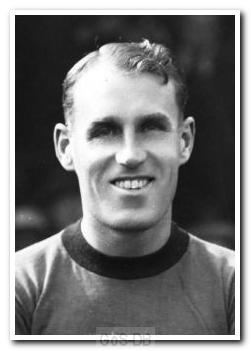
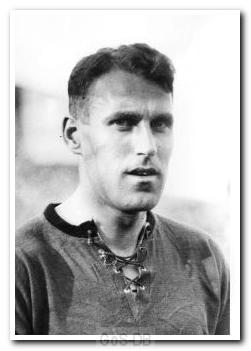
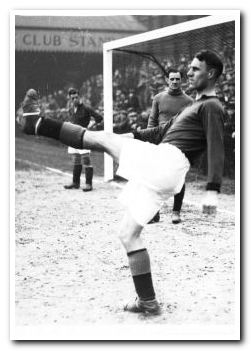
JIMMY RAE
Note: Rae's birthplace was not Blackmill, Argyllshire, as is often documented - see the 'Your Contribution' section for more details.
Full Name: James Clarkson Rae
Born: 22 November 1907
1. Came from: Partick Thistle Went to: Career interrupted by WW2
1. First game: 27 August 1932 Last game: 13 May 1940
2. Came from: Career interrupted by WW2 Went to: Appointed Assistant Manager
2. First game: 07 April 1945 Last game: 08 December 1945
Appearances: 287 (287/0) Goals: 0
James Rae was a left-back and was born in the village of Skinflats, near Falkirk in Stirlingshire (see also the 'Your Contribution' note, below, for further details). He was an outstanding teenager who captained Scotland schoolboys and then began his senior football career with Stirlingshire side King's Park. At the age of 17, he signed as a part-time professional with the club, whilst continuing to complete his apprenticeship as an electrician. The club later became the modern-day Stirling Albion and Rae played for them from 1925 to 1929, appearing 145 times for the club, scoring three goals in the newly created Second Division of the Scottish Football League.
In 1929, he moved to Partick Thistle, where he stayed for three years. It was whilst at Thistle that he triggered a move to Home Park - along with striker John Simpson - after both impressed while playing for Thistle against Argyle in a benefit match for fellow Scot and Pilgrim, Alec Hardie, at Home Park. Rae would go on to be a success, whereas Simpson fared less well, lasting just a season, playing five times and scoring twice. Rae was also being courted by Rangers at the time, but was lured to the club via Bob Jack using photos of the region. Whilst he returned to Scotland after the Hardie benefit match, having not signed for Argyle, he had given Jack his word and whilst Rangers continued to prevaricate, he kept his word to Jack and duly signed. He later described Jack as 'one of the greatest managers in the game'. In total, he had played 88 times and scored twice for Thistle and had also picked up a Scottish Cup runner-up medal in 1929-30 after losing in the Final's replay to Rangers 2-1, at Hampden Park, after the initial game finished 0-0.
The defender that arrived in Devon was ahead of his time; always preferring to pass the ball away from danger rather than take the safety-first option of a hefty clearance - he was perhaps an Alan Hansen before Alan Hansen - another Partick defensive product, ironically, in later years. Rae's culture was offset by his 'hard man' partner, Harry Roberts, who played many games alongside him. In eight seasons, Rae made nearly 300 appearances in green, until the Second World War brought his career to a premature halt. In his time at the club, it was often felt he could and should have won full Scottish honours, to further his schoolboy captaincy, but the call never came, though he did end up on the reserve-list three times.
Remaining loyal to Argyle, Rae played four times in the Football League West Cup in the spring of 1945 and made two further appearances in the interim Football League South season of 1945-46.
He was then appointed as assistant manager, a role he filled until his elevation to the hot seat early in the 1947-48 season, taking over from Jack Tresadern, a post Rae would go on to hold for eight years. Although the club was relegated in 1949-50, he led Argyle to promotion to Division Two in 1951-52 and to their equal-highest finishing position of fourth in that Division in 1952-53.
Another legacy of his was that he was responsible for signing players of the calibre of Jack Chisholm, Neil Dougall and Gordon Astall, amongst others. Despite his successes, he also spent much of his managerial career fending off the threat of relegation and he was dismissed in January 1955. This brought to an end a remarkable twenty-year association with the club as player, assistant-manager and then manager. Argyle went for a big name to replace him, bringing in Jack Rowley as player-manager, initially, from Manchester United. Yet over five seasons, his record was not markedly better than Rae's.
Rae may have been watching on from afar, noting the very same. He had left Plymouth to manage a pub in Solihull, but sadly died in July 1958, just over three-and-a-half years after leaving the club, aged just 50 years old.
YOUR CONTRIBUTION
If you can add to this profile, perhaps with special memories, a favourite story or the results of your original research, please contribute here.
From Steve Dean (GoS owner) in Plymouth on 07/02/2014 ...
Jimmy Rae's birthplace is often said to be Blackmill, with some books and websites suggesting it was Blackmill, Argyllshire, or even Aberdeenshire. However, the Statutory Records of Births in Scotland, accessed through the ScotlandsPeople website, reveals just one birth for James Clarkson Rae at this time - he was born in Skinflats (spelt Skinflatts on the registration document) in the district of Bothkennar, Stirlingshire, a small village that now lies within the Falkirk council area. Close by are the towns of Falkirk, Stenhousemuir and Grangemouth, and some ten miles away is Stirling, where Rae's first club, King's Park, used to play.
So where did 'Blackmill' come from? A paper entitled 'Material for a Place-Name Survey of East Stirlingshire' (download available from the Scottish Place-Name Society website, here: http://www.spns.org.uk/CtStirling.html) lists a place called Blackmill at National Grid Reference NS889830, which is about a mile from Skinflats. Whilst Blackmill is not marked at this location on today's maps, it seems too much of a coincidence that within a stone's throw of the grid reference is Blackmill Crescent in the village of Carron (on Falkirk's northern edge), and very close by is a pub, now called the Shore at Carronshore, but formerly the Blackmill Arms.
APPEARANCE DETAILS [reselect competitions]
The details below reflect appearances in all first-team competitions.
I'm very grateful to many who have helped write GoS-DB's player pen-pictures, and to Dave Rowntree, the PAFC Media Team and Colin Parsons for their help with photos. Thanks also to staff at the National Football Museum, the Scottish Football Museum and ScotlandsPeople for their valuable assistance.
The following publications have been particularly valuable in the research of pen-pictures: Plymouth Argyle, A Complete Record 1903-1989 (Brian Knight, ISBN 0-907969-40-2); Plymouth Argyle, 101 Golden Greats (Andy Riddle, ISBN 1-874287-47-3); Football League Players' Records 1888-1939 (Michael Joyce, ISBN 1-899468-67-6); Football League Players' Records 1946-1988 (Barry Hugman, ISBN 1-85443-020-3) and Plymouth Argyle Football Club Handbooks.
Greens on Screen is run as a service to fellow supporters, in all good faith, without commercial or private gain. We have no wish to abuse copyright regulations and apologise unreservedly if this occurs. If you own any of the material on this site, and object to its inclusion, please get in touch using the 'Contact Us' button at the top of the page.