 Contact Us
About GoS
Now in its 28th year, and
Contact Us
About GoS
Now in its 28th year, andstill amateur & advert-free Please do not copy GoS
material without asking
Can you help? This page is the result of the best endeavours of all concerned. If you spot a mistake or know of facts to add, or have a better photo, please get in touch using 'Contact Us' (top, right).
Back to GoS-DB Hub Find Another Player
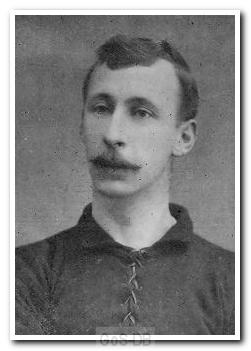
BOB JACK
Note: 1) At least two sources say that he also played for Burslem Port Vale before joining Argyle, but others suggest that this was not the case. (2) At least one record book says that all four goals in the match at Northampton on 9th Sep 1905 were scored by Fred Buck. However, the match reports in the Western Morning News, Western Evening Herald and many national newspapers show that the second goal was scored by Bob Jack. The totals for each player are therefore different from those in many record books. (3) At least two record books list Argyle's goalscorers for the FA Cup match against Freemantle on 14th Nov 1903 as Peddie (2), Winterhalder and Picken (2), but reports of the match in the Western Morning News, Western Evening Herald and other newspapers clearly describe the goals by Peddie, Picken (2), Jack and Anderson. The overall goal totals for Peddie, Winterhalder, Jack and Anderson are therefore different from some other sources.
Full Name: Robert Jack
Born: 04 April 1876
1. Came from: Glossop Went to: Appointed Manager
1. First game: 01 September 1903 Last game: 28 April 1906
2. Came from: Southend Went to: Manager
2. First game: 03 December 1910 Last game: 03 December 1910
Appearances: 105 (105/0) Goals: 9
Jack began his football career with his hometown club, Alloa Athletic, in 1891 before also representing Fifeshire. In 1893 he joined Bolton Wanderers, where he spent six seasons. Playing at outside-left, he made 110 appearances and scored 29 goals, establishing a reputation as one of the game’s quickest wingers.
A serious ankle injury brought his time at Bolton to an end and, in 1901, he signed for Preston North End. After one season with the Lilywhites, he moved to Glossop before joining Plymouth Argyle in 1903 as the club’s first professional player. He made his debut in Argyle’s first match as a professional club, a Western League fixture against West Ham United on 1 September 1903.
Jack quickly became an important member of the side. His pace and direct running made him a constant threat on the left wing, and he missed only two competitive matches during the 1903-04 season. The Argyle Handbook for 1904-05 described him as “our famous flier”, adding that “probably last season was the best in the player’s history”. He scored nine goals in 105 appearances for Argyle before bringing his playing career at Home Park to a close in April 1906.
Following the departure of Frank Brettell in 1905, Jack was appointed player-manager, becoming the first man to combine the two roles at Argyle. Although he continued to appear in the first team during the early part of the 1905-06 season, his managerial responsibilities increasingly took precedence. He left the club after one season in charge following a disagreement with the board.
Jack moved to Southend United as player-manager, where he spent four seasons and guided the club to two Southern League Division Two championships. In 1910 he returned to Argyle as manager and secretary, making one final playing appearance before concentrating entirely on management.
His second spell established him as one of the most influential figures in the club’s history. During the next 28 years he oversaw Argyle’s development from a leading Southern League side into an established Football League club. Under his management, Argyle won the Southern League championship in 1912-13 and, following the club’s election to the Football League in 1920, became a founding member of the Third Division. After six successive runner-up finishes in Division Three (South), Jack’s side finally secured the championship and promotion to the Second Division in 1929-30. He remained manager until retiring in 1938.
Football remained a family affair. His sons David and Rollo both played for Argyle, while another son, Donald, was also registered by the club but did not make a first-team appearance.
After retiring, Jack returned to Southend, where he later worked as a scout and club representative. Away from football he enjoyed success as a bowls player, winning the Essex singles championship and representing England against Scotland in 1922. He died in Southend-on-Sea in May 1943 aged 67. In accordance with his wishes, his ashes were scattered over the pitch at Home Park in recognition of his long association with Argyle.
YOUR CONTRIBUTION
If you can add to this profile, perhaps with special memories, a favourite story or the results of your original research, please contribute here.
APPEARANCE DETAILS [reselect competitions]
The details below reflect appearances in all first-team competitions.
I'm very grateful to many who have helped write GoS-DB's player pen-pictures, and to Dave Rowntree, the PAFC Media Team and Colin Parsons for their help with photos. Thanks also to staff at the National Football Museum, the Scottish Football Museum and ScotlandsPeople for their valuable assistance.
The following publications have been particularly valuable in the research of pen-pictures: Plymouth Argyle, A Complete Record 1903-1989 (Brian Knight, ISBN 0-907969-40-2); Plymouth Argyle, 101 Golden Greats (Andy Riddle, ISBN 1-874287-47-3); Football League Players' Records 1888-1939 (Michael Joyce, ISBN 1-899468-67-6); Football League Players' Records 1946-1988 (Barry Hugman, ISBN 1-85443-020-3) and Plymouth Argyle Football Club Handbooks.
Greens on Screen is run as a service to fellow supporters, in all good faith, without commercial or private gain. We have no wish to abuse copyright regulations and apologise unreservedly if this occurs. If you own any of the material on this site, and object to its inclusion, please get in touch using the 'Contact Us' button at the top of the page.